


If you’ve followed Grove Life for a while, you already know that I’m a big believer in American elderberry.
We grow, harvest, and experiment with ways to use it. And as our first harvest has come in this year, I’ve been working on turning some of those beautiful dark berries into value-added products that we can sell through Twilight Grove.
But there’s another side to producing food that isn’t nearly as photogenic as a basket full of ripe elderberries: Making sure the food we sell is actually safe.
And elderberries present some unique challenges.

Elderberries Aren’t a High-Acid Fruit
People sometimes lump elderberries in with other berries when thinking about jams and jellies. But from a food-safety standpoint, elderberries need some special consideration.
According to newly published guidance from University of Missouri Extension, elderberries are naturally a low-acid fruit. For a shelf-stable elderberry jam or jelly, the product needs to be made using a scientifically supported formulation and properly acidified. MU recommends verifying a finished equilibrium pH below 4.6 and soluble solids above 65° Brix.
Why does that matter? Botulism.
Clostridium botulinum can grow under the wrong conditions in inadequately acidified and processed low-acid foods and produce botulinum toxin. Botulism is rare, but it can cause paralysis and even death.
That isn’t something I’m willing to shrug off because we’re a small farm.
If anything, selling food directly to people in our community makes me feel more responsible for understanding how to make it safely.

So I Asked the Experts
Earlier this year, I wanted to know whether I could legally and safely make elderberry jam or jelly in my home kitchen, process it in a boiling-water bath, and sell it under Missouri’s cottage food law.
I reached out to food-safety professionals with both University of Missouri Extension and Kansas State University Extension.
At the time, the answer I received from both was essentially:
Don’t do it - not without having the particular recipe and process evaluated by a process authority.
That was disappointing.
Missouri’s cottage food provisions allow certain foods to be made in a home kitchen and sold directly to consumers. But I wasn’t interested in finding a technical loophole that would let me put something in a jar and sell it.
I wanted to know that it was safe.
So elderberry jam and jelly went onto my growing list of things I’d like to make someday when I have access to the right facility and process validation.
Or so I thought.

Then MU Extension Went Back to Work
This is where I have to give some serious credit to Whitney Schmidt with University of Missouri Extension.
Whitney didn’t just answer my original question and move on. She continued looking into it and consulting with food-processing experts at MU.
And in August 2026, MU Extension published a brand-new resource:
It was written by Lakshmikantha Channaiah, State Specialist in Food Processing, and Whitney Schmidt, Research Project Analyst.
And tucked into that guidance was the answer I’d been hoping for:
Yes. Properly prepared traditional elderberry jam and jelly can qualify for production in a home kitchen under Missouri cottage food law.
That is a pretty exciting development for Missouri elderberry growers and small-scale producers…but there’s a very important asterisk attached.

“Cottage Food” Doesn’t Mean “Anything Goes”
The new guidance isn’t permission to grab any elderberry jelly recipe from Pinterest, fill some jars, run them through a water bath and head to the farmers market.
MU specifically says that not all elderberry jams and jellies qualify.
Traditional products made with standard recipes may be eligible. Sugar-free, reduced-sugar, sugar-substitute and low-acid versions are not eligible for home-kitchen production under Missouri cottage food law.
MU describes a safe shelf-stable elderberry preserve as one made by cooking elderberries or elderberry juice with sugar, an acidifying ingredient such as bottled lemon juice or food-grade citric acid, and pectin if needed. The hot product is placed into jars and then processed in a boiling-water bath according to a tested recipe.
MU also recommends testing every batch with a calibrated, reliable pH meter and keeping records.
For me, that’s not an unreasonable burden - it’s responsible food production.

So, What Recipe Can You Use?
If you’re a Missouri producer reading this and thinking, Okay, but where do I find a scientifically supported elderberry jam or jelly recipe? - there are some excellent resources already available.
University Extension publications are one of my favorite places to start. Unlike recipes pulled from a blog, Pinterest or an old family cookbook, Extension food-preservation recommendations are based on food-safety research and tested processing methods. When we’re talking about a low-acid fruit like elderberry, that distinction matters.
The University of California Cooperative Extension has published an Elderberry Jam recipe using crushed elderberries, pectin and sugar. Importantly, the recipe specifies ingredients by weight and provides boiling-water or atmospheric-steam canning times, including adjustments for elevation.
University of California Elderberry Jam recipe
For jelly, Penn State Extension has published a Safe Elderberry Jelly Recipe for Canning. Their guidance specifically addresses the problem that started this whole conversation: researchers have found that elderberry acidity can vary considerably among varieties and growing conditions.
The Penn State recipe uses a very specific ratio of elderberry juice, bottled lemon juice, pectin and sugar. They emphasize that the ingredients should be weighed rather than measured by volume, and that bottled lemon juice should be used because its acidity is consistent.
Penn State Extension Safe Elderberry Jelly Recipe for Canning
That specificity is important. A scientifically supported recipe isn’t simply an ingredient list that happens to make good jelly. The proportions and processing method are part of what makes the finished product safe.
So if you find a tested Extension recipe, resist the temptation to “improve” it by cutting the sugar, reducing the lemon juice, changing ingredient ratios or otherwise altering the formulation. Penn State’s jelly recipe, for example, calls for the filled half-pint jars to be processed in a boiling-water canner for 10 minutes, with processing time adjusted for altitude.
For those of us developing products on a small scale, Extension agencies are an incredible resource. We don’t have to reinvent the food-safety science ourselves - we just have to be willing to find the research, follow it, and resist treating a tested formulation like a recipe that can be casually tweaked.
And that’s exactly where I’m starting with Twilight Grove elderberry jelly.

This Guidance Is Specifically for Jam and Jelly
There’s another distinction here that’s really important:
This new guidance applies to qualifying traditional elderberry jams and jellies. It is not a blanket approval for making other shelf-stable elderberry products in a home kitchen.
That’s especially relevant because I’m also working toward producing shelf-stable elderberry juice at Twilight Grove.
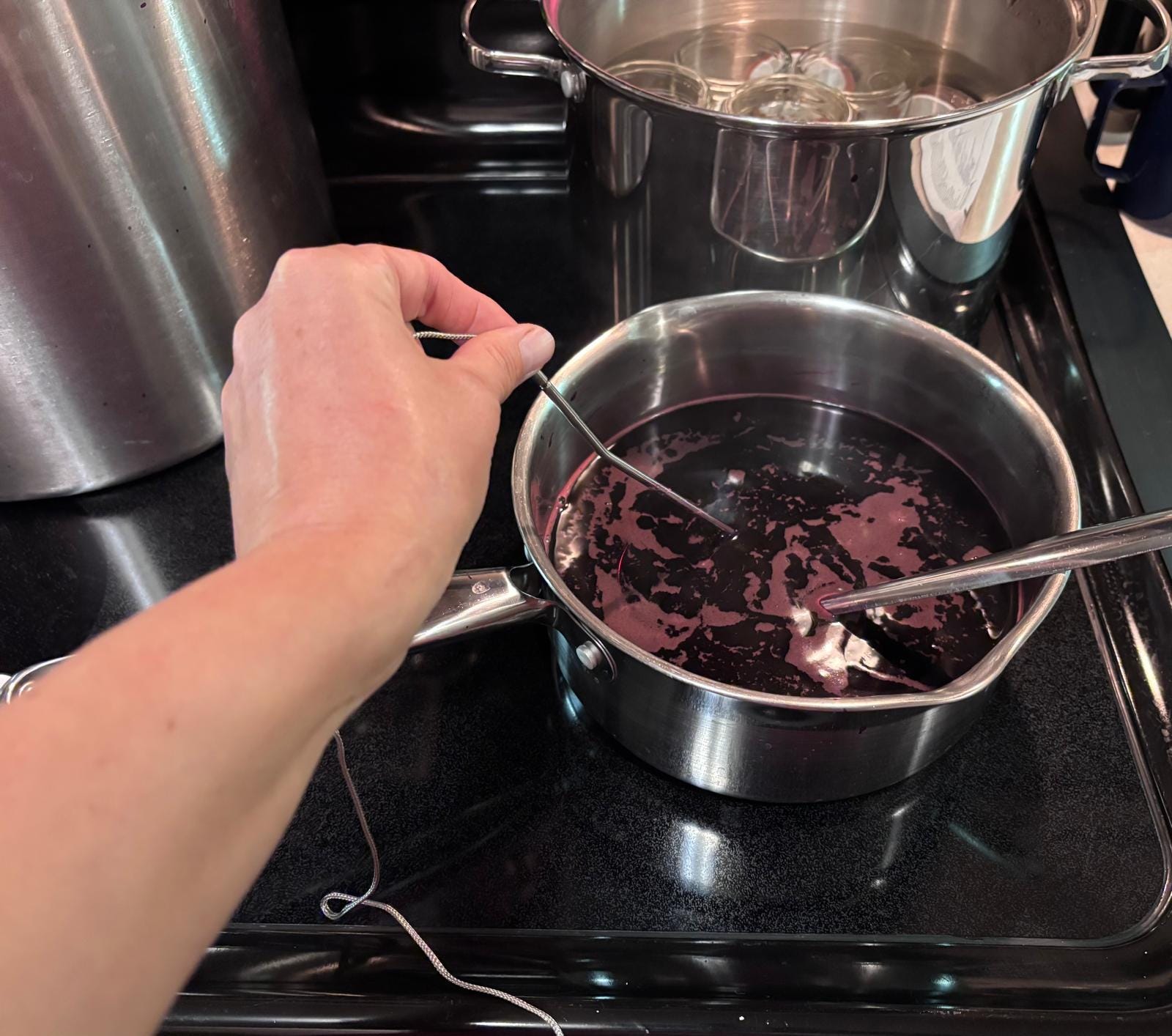
Juice is an entirely different regulatory animal.
The path I’m following for commercial shelf-stable elderberry juice involves production in an appropriate inspected facility, Juice HACCP requirements and training, a written HACCP plan, identification and control of food-safety hazards, and development of an appropriate process for the finished product.
So while this new MU guidance has opened the door for me to make traditional elderberry jelly under Missouri’s cottage food provisions, it hasn’t suddenly made every elderberry product a cottage food - and that’s an important distinction.
Different products achieve shelf stability in different ways.
You can’t take the fact that a properly formulated and processed elderberry jelly can safely sit on a shelf and assume that a bottle of elderberry juice can, too.
MU’s new publication itself is specifically titled Elderberry Jam and Jelly, and its home-kitchen provision applies to elderberry jam and jelly produced for qualifying direct-to-consumer cottage-food sales. Products intended for wholesale or out-of-state markets require an inspected food manufacturing facility.
For Twilight Grove, that means I’m pursuing these as two very different product-development paths: jelly under Missouri cottage food provisions, and shelf-stable juice through the much more rigorous commercial processing route.

Sugar Is Doing More Than Making Jelly Sweet
One of the most interesting things I learned from the new MU guidance is just how important sugar is to the safety of a traditional jam or jelly.
We tend to think of acid as the big safety factor in home canning - and it certainly matters here.
But sugar provides another important hurdle.
MU explains that the sugar concentration in the recipe reduces the product’s water activity (aw) to 0.85 or below. That is significant because it is below the threshold at which the primary food-safety hazard can grow.
That’s also why you can’t simply decide that a recipe has “too much sugar” and cut it in half.
Changing the sugar isn’t just changing the sweetness.
You’re potentially changing the safety characteristics of the food.
The same goes for changing the acidification, ingredients or processing method. MU specifically warns that recipe changes can affect product safety and should be evaluated before commercial production.
This is one of those places where understanding a little of the science behind food preservation changes the way you look at a recipe. Sugar, acid and heat aren’t simply there for flavor and texture. Together, they help create a product in which dangerous microorganisms cannot grow.

What This Means for Twilight Grove
For me, this new guidance opened one very specific door that I thought was going to remain closed until we had regular access to a commercial kitchen.
It means I can begin producing a traditional elderberry jelly for direct-to-consumer sales under Missouri cottage food law - as long as I follow an appropriate formulation, processing procedure, testing protocol and labeling requirements.
It doesn’t change the path I’m taking with other products, such as shelf-stable elderberry juice. That product is still following a commercial product-development path with its own food-safety and regulatory requirements.
Different elderberry products present different food-safety risks, and they don’t all fit under the same regulations.
And yes, for the jelly, there will be records.
MU recommends keeping equilibrium pH results, soluble-solids/Brix results, formulation records, production batch records, ingredient supplier information and other food-safety documentation.
And I’m okay with that - because there’s something important happening here beyond one little jar of jelly.

Small Farms & Producers Can Take Food Safety Seriously
There’s sometimes a false choice presented to small food producers:
Either you’re a huge commercial food manufacturer with laboratories, quality-control departments and industrial equipment...or you’re somebody’s grandma making jam in the kitchen and hoping for the best.
There’s a whole lot of space between those two things.
Small producers can learn about pH, water activity and Brix. We can calibrate meters, keep batch records, and follow scientifically supported formulations. We can take HACCP courses and food-safety training.
And when we don’t know the answer, we can ask somebody who does.
MU’s new guidance recommends HACCP and home-canning education for small processors and emphasizes sanitation, employee hygiene, packaging integrity, recordkeeping and other good manufacturing practices. Although formal food-safety training may not be required for some small businesses, producers are still responsible for identifying and controlling hazards in their products.
That doesn’t make small-scale food production less charming or less local - it makes it better.

Sometimes “No” Really Means “We Need Better Information”
I’m especially grateful that Whitney didn’t stop with the safest easy answer.
When I first asked whether I could sell water-bath-canned elderberry jelly, telling me no was entirely reasonable based on the information available at the time.
But she kept asking questions. She involved people with more specialized food-processing expertise. And eventually that work resulted in new guidance that other Missouri elderberry growers and cottage food producers can use, too.
That’s Extension working exactly the way it should: taking real questions from growers and producers, bringing science and regulatory expertise to the problem, and turning the answer into practical information that the rest of us can actually use.
So, yes: There is now elderberry jelly at Twilight Grove.
But I’m almost as excited about why there’s elderberry jelly. It represents another small step in figuring out how we can take what we’re growing here at Grove Farm and turn it into safe, locally produced foods - without cutting corners along the way.
Because botulism is no joke.
Food safety isn’t just something big companies have to think about. And the people who buy food from a small farm deserve every bit as much care as anyone else.

A Note for Other Missouri Producers
This post describes my experience and my understanding of the newly published MU Extension guidance; it isn’t a substitute for regulatory or process-authority advice.
If you’re considering producing elderberry jam or jelly yourself, please read MU Extension’s complete publication rather than relying on this post alone. The publication itself makes clear that its guidance is educational and isn’t a substitute for regulatory review, process-authority evaluation, legal advice or development of a food-safety plan.
And don’t assume that because one elderberry jelly formulation is safe, yours automatically is too.
Formulation matters. Acidification matters. Sugar concentration matters. Processing matters. Sanitation matters. Testing matters.
MU recommends starting with a scientifically supported formulation, confirming that the finished product meets applicable safety standards - including equilibrium pH below 4.6 and soluble solids above 65° Brix - and maintaining testing and production records for every batch.
Safe food first. Jelly second.


Woah, Julianne, you are a FORCE!!
Doing it right for the community!